Most small businesses in Nigeria believe paid ads are only for big brands. That’s simply not true. With a ₦50,000 ad budget, a clear goal, and a disciplined process, you can generate hundreds of real leads. In this guide, we’ll walk you through the full breakdown, step by step, so you can copy the approach for your own business.
I’ve spent about 15 years in SEO, paid ads, email marketing, and campaign management, working with corporates and SMEs across Nigeria. Small budgets have taught me more than big ones ever did. When money is tight, every naira has to earn its place. Let’s dive in.
Why a ₦50,000 Ad Budget Can Still Win in Nigeria
A ₦50,000 ad budget sounds small, but it isn’t useless. Nigerian ad auctions are still cheaper than those in the US or UK. Cost per click on Facebook and Instagram is often only a fraction of what advertisers pay abroad. That’s your opening.
Here’s the catch, though. A small budget leaves no room for guesswork. You can’t afford to “test everything.” You have to be sharp about who you target, what you offer, and how fast you respond.
Think of it like cooking for a family with a limited food budget. You won’t buy random ingredients. You’ll plan the meal, buy exactly what you need, and waste nothing. Small-budget advertising works the same way.
The Math Behind 500 Leads
Let’s start with the simple arithmetic. ₦50,000 divided by 500 leads equals ₦100 per lead. That’s the target cost per lead (CPL).
Is ₦100 per lead realistic? For low-friction offers like a free guide, a WhatsApp enquiry, or a discount voucher, it can be. For high-ticket services, it’s tougher, and you’d expect to pay more. The trick is choosing an offer that’s easy to say “yes” to.
Here’s how the numbers break down:
- Total budget: ₦50,000
- Target leads: 500
- Target CPL: ₦100
- Campaign length: 14 days
- Daily spend: about ₦3,570
Who This Breakdown Is For
This guide suits you if you’re a small business owner, a freelancer, or a marketer handling SME clients. It works well for service businesses, online shops, training providers, real estate agents, and event promoters. If you sell something people can enquire about quickly, you’re in the right place.
Step 1: Define a Narrow Goal and Audience
Every campaign that wastes money starts with a vague goal. “Get more customers” isn’t a goal. “Collect 500 WhatsApp enquiries for our free consultation in 14 days” is.
Pick One Offer, Not Five
With a ₦50,000 ad budget, you must focus on one offer. Splitting your money across multiple products spreads your data too thin. The ad platform needs enough results to learn who responds. One offer gives it that signal faster.
Ask yourself these questions:
- What single action do I want people to take?
- What’s the easiest first step for a stranger?
- What can I give away that costs me little but feels valuable?
Build a Simple Buyer Profile
You don’t need a fancy persona document. Write down five things: age range, location, job or lifestyle, biggest problem, and where they spend time online. For example, “women aged 25 to 40 in Lagos who want affordable home décor ideas and use Instagram daily.”
The tighter the profile, the better your targeting and the sharper your ad copy will be. Broad audiences burn cash quickly on small budgets.
Step 2: Build an Offer People Can’t Ignore
Your offer is the engine. A weak offer with a great ad still fails. A strong offer with an average ad often succeeds.
In Nigeria, people respond well to things that feel practical, free, and quick. Think free consultations, free price lists, free samples, discount vouchers, or short training sessions. Trust matters here too. Many buyers have been burned by online sellers, so your offer should reduce risk.
The Lead Magnet Checklist
Before you spend a single naira, check your offer against this list:
- Solves one specific problem. It shouldn’t try to fix everything.
- Delivers value quickly. Nobody wants a 50-page PDF.
- Feels free of risk. No payment, no long forms.
- Connects to your paid service. The lead magnet should lead naturally to a sale.
- Is easy to explain in one sentence.
A good example is “Get a free 15-minute home design consultation on WhatsApp.” It’s clear, personal, and low-risk. A weak example is “Sign up for our newsletter.” Nobody gets excited about that.
Step 3: Create a Fast, Focused Landing Experience
Once someone clicks your ad, where do they go? This step quietly decides whether your ₦50,000 ad budget works or leaks.
Many Nigerian users browse on mobile data, often on average connections. Slow pages lose people instantly. Keep your landing experience light, clear, and mobile-first.
Forms vs. WhatsApp Click-to-Chat
We tested two lead paths, and both have a place:
| Option | Best For | Pros | Cons |
|---|---|---|---|
| Meta Instant Form | Collecting phone and email quickly | Pre-filled details, low friction | Some leads are less serious |
| WhatsApp click-to-chat | Service enquiries, quick sales | Instant conversation, high trust | Needs fast replies |
| Short landing page | Building an email list | Full tracking, more control | Slower to build and load |
For our model, we used a mix of Instant Forms and WhatsApp. WhatsApp leads tended to be warmer, because people had already started a conversation. Forms gave us volume at a lower cost.
If you use a landing page, keep it to one headline, three bullet benefits, one image, and one button. Remove the menu. Remove distractions. Make the next step obvious.
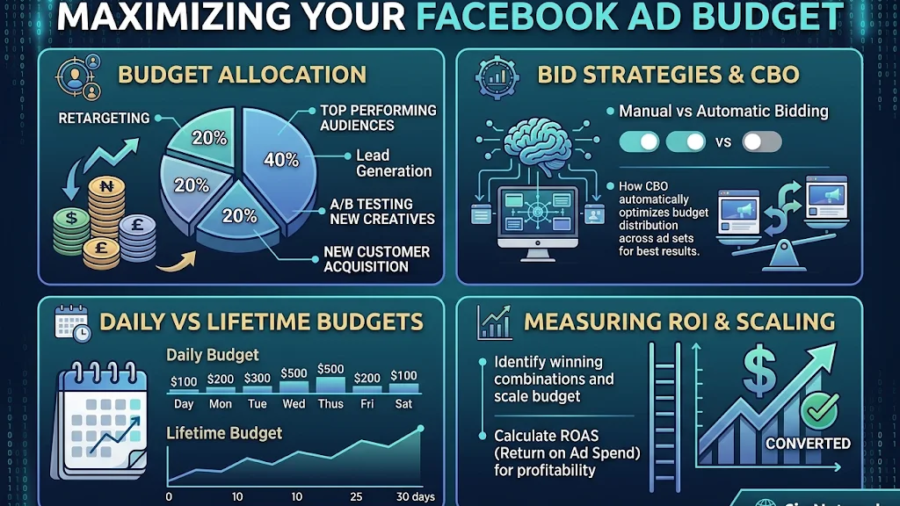
Step 4: Split the Budget Wisely
Now comes the part everyone wants to see. How do you actually divide ₦50,000?
We didn’t throw it all at one ad set. We also didn’t scatter it across ten. We used a simple three-part split.
The Budget Table
| Campaign Type | Budget | Purpose | Target Leads | Approx. CPL |
|---|---|---|---|---|
| Meta Instant Form (cold audience) | ₦30,000 | Volume of leads | 300 | ₦100 |
| WhatsApp click-to-chat | ₦12,000 | Warm, high-intent leads | 140 | ₦86 |
| Retargeting (video viewers, page visitors) | ₦8,000 | Recover missed leads | 60 | ₦133 |
| Total | ₦50,000 | 500 | ₦100 |
Retargeting costs more per lead, but it brings back people who already showed interest. That’s often where the best-quality leads hide.
We also kept about 10 percent of each budget flexible. If one ad performed far better, we moved money to it quickly. That’s the secret of a small budget: stay nimble.
Step 5: Write Ads That Stop the Scroll
Your creative is your first impression. On a crowded feed, you’ve got about two seconds to earn attention.
Creative Rules That Worked
Here’s what consistently helped us:
- Lead with the problem or the benefit. “Tired of overpriced décor?” beats “Welcome to our company.”
- Use real images or short videos. Authentic phone-shot clips often beat polished stock photos.
- Show the price or the “free” clearly. People in Nigeria are price-aware, so be upfront.
- Write like you talk. Simple, friendly language wins.
- Add one clear call to action. “Tap to chat on WhatsApp” is better than “Learn more.”
- Include proof. A testimonial, a number, or a quick result builds trust.
Here’s a sample structure for your ad copy:
- Hook: Call out the audience and problem.
- Value: Explain what they’ll get.
- Proof: Add a quick result or testimonial.
- Action: Tell them exactly what to do.
We ran three creatives per audience: one image, one short video, and one carousel. That gave the platform enough variety to learn, without eating the whole budget on testing.
Step 6: Launch, Test, and Cut Losers Fast
Launching is exciting, but the real work starts in the first 72 hours. You need to watch the numbers closely and make quick decisions.
Don’t panic on day one. Ad platforms need a short learning period. But don’t be sentimental either. If an ad is clearly failing, pause it.
Daily Check Routine
What to Review Each Morning
Spend 10 minutes every day on these metrics:
- Cost per lead: Is it near your ₦100 target?
- Click-through rate (CTR): Under 1 percent usually signals weak creative.
- Frequency: If it climbs above 3 quickly, your audience is tiring.
- Lead quality: Are people replying and answering your follow-up?
Our rule was simple. After about ₦2,000 spent on an ad with no leads, we paused it. After an ad beat the target CPL, we moved extra budget to it in small steps of 20 percent. Big jumps can reset the learning phase, so go gradually.
For official guidance on structuring campaigns, the Meta Business advertising resources are a helpful reference, especially for understanding objectives and the learning phase.
Step 7: Follow Up Within the Hour
Here’s a hard truth. Most lead generation campaigns fail after the lead arrives, not before. A lead that waits two days for a reply is already cold.
We set a simple rule: respond within 60 minutes during working hours. That single habit often matters more than any ad tweak.
Here’s the follow-up system we used:
- Instant auto-reply. A friendly message confirming we got their details.
- Personal message within one hour. A real human greeting, using their name.
- Value-first conversation. Ask one question about their need before pitching.
- Second touch after 24 hours. A gentle reminder with a helpful tip.
- Third touch after 3 days. A limited-time offer or testimonial.
- Email nurture. For those who gave an email, a short 3-part sequence.
Email still works brilliantly in Nigeria for nurturing. A short, helpful sequence can turn a lukewarm lead into a paying customer. It also lets you reach people again without paying for ads every time.
Results Breakdown and Key Numbers
So what did the ₦50,000 ad budget actually deliver in this model? Let’s look at the funnel.
| Metric | Result |
|---|---|
| Total spend | ₦50,000 |
| Total leads | 500 |
| Average cost per lead | ₦100 |
| Leads who replied to follow-up | about 45 percent |
| Qualified conversations | about 120 |
| Paying customers (example 8 percent of qualified) | about 10 |
These numbers show something important. Leads aren’t sales. A cheap lead is only valuable if you can convert it. That’s why tracking beyond the form is vital.
If your average sale is worth ₦25,000, ten customers means ₦250,000 in revenue from a ₦50,000 ad budget. That’s a 5x return before costs. Your numbers will differ, but the logic holds.
Always calculate your cost per acquisition, not just cost per lead. That’s the figure that decides whether your campaign is truly profitable.
Common Mistakes to Avoid
Even smart marketers trip up on small budgets. Watch out for these traps:
- Targeting too broadly. “All of Nigeria, ages 18 to 65” wastes money.
- Running too many ads. Each one needs budget to learn.
- Ignoring mobile experience. Most of your audience is on phones.
- Slow follow-up. Speed beats polish every time.
- Chasing cheap leads. The lowest CPL isn’t always the best quality.
- Skipping tracking. Without the Meta Pixel and conversion events, you’re guessing.
- Changing too much too soon. Constant edits confuse the algorithm.
Think of your campaign like a young plant. It needs steady care, not daily uprooting to check the roots.
Frequently Asked Questions
1. Can a ₦50,000 ad budget really generate 500 leads?
Yes, it’s possible when your offer is low-friction, your targeting is tight, and your creative is strong. A ₦100 cost per lead is achievable for free or low-commitment offers. For high-ticket services, expect a higher CPL.
2. Which platform is best for a small budget in Nigeria?
Facebook and Instagram are usually the best starting point because of their reach, flexible targeting, and low costs. Google Ads can work well for people actively searching for your service, but clicks often cost more.
3. How long should I run the campaign?
Aim for at least 10 to 14 days. That gives the platform time to learn and gives you enough data to make good decisions. Stopping after two days rarely tells you anything useful.
4. What’s the difference between a lead and a sale?
A lead is someone who showed interest by sharing contact details or starting a chat. A sale happens when they pay. Strong follow-up is what turns leads into sales.
5. Should I use a landing page or Instagram and Facebook lead forms?
It depends on your goal. Instant forms are faster and cheaper for volume. Landing pages give better tracking and help you build an email list. WhatsApp click-to-chat works well for service businesses that sell through conversation.
6. How do I know if my ads are working?
Track cost per lead, click-through rate, lead quality, and cost per acquisition. If your CPL is near target and leads reply to your messages, you’re on the right path. If leads go silent, review your targeting and offer.
7. Do I need a professional to run my ads?
Not always. Many small business owners can launch simple campaigns themselves. But if you’re managing client money or scaling up, an experienced specialist can save you from costly mistakes.
Conclusion
Turning a ₦50,000 ad budget into 500 leads isn’t magic. It’s a repeatable process built on seven habits: a narrow goal, a strong offer, a fast landing experience, a smart budget split, scroll-stopping ads, disciplined testing, and rapid follow-up.
The biggest lesson is that small budgets reward focus. When you can’t afford waste, you learn what truly matters. Start with one offer, one audience, and one clear action. Track everything, cut what fails, and double down on what works.
If you’re ready to try it, pick your offer today, set up your tracking, and launch a small test. Your first 500 leads may be closer than you think.







Leave a Comment
You must be logged in to post a comment