
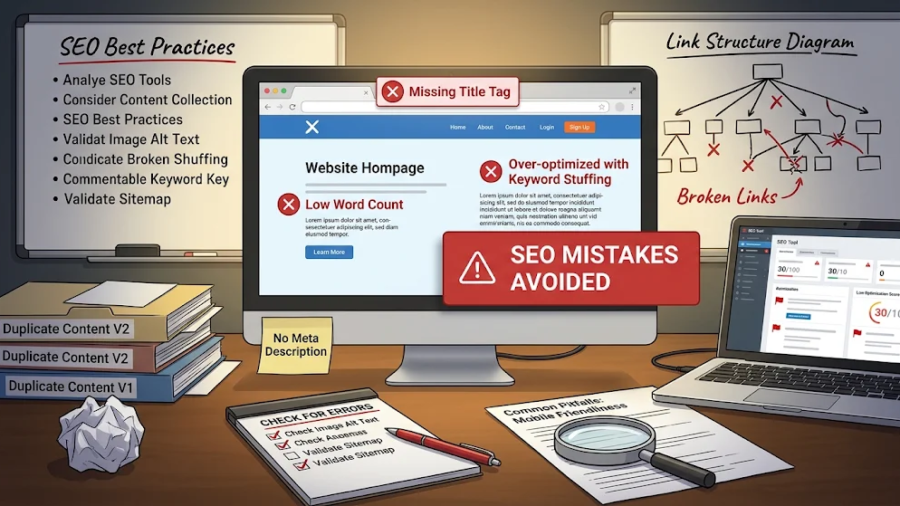
Your website may look great. However, it could be losing most of its visitors. Search engines reward sites that follow clear rules. Break those rules, and your rankings drop fast. Let’s look at the biggest SEO mistakes and fix each one.
Why Your Organic Traffic Is Dropping
Traffic rarely falls for one reason. Instead, small errors pile up over time. Google updates its algorithms often. Therefore, old tactics stop working. Many site owners never notice the damage. They only see the traffic graph sliding down.
Audit your site first. Then find the weak spots. Finally, fix them in order of impact.
Mistake 1: Ignoring Search Intent
Many pages target the wrong intent. A visitor wants a guide, but your page sells a product. As a result, they leave quickly.
How to fix it:
- Search your target keyword on Google.
- Study the top five results.
- Match their format, depth, and angle.
- Then add unique value they lack.
Intent drives rankings. Match it, and traffic follows.
Mistake 2: Targeting the Wrong Keywords
Broad keywords look attractive. However, they bring unqualified visitors. Competition is also fierce. Long-tail keywords convert better and rank faster.
How to fix it:
- Use keyword research tools to find low-competition phrases.
- Focus on questions your customers ask.
- Group related keywords by topic.
- Assign one main keyword per page.
Moreover, avoid keyword stuffing. Write naturally for people first.
Mistake 3: Slow Page Speed
Speed affects both rankings and user behavior. Most visitors leave after three seconds of loading. Consequently, your bounce rate climbs.
How to fix it:
- Compress images before uploading.
- Enable browser caching.
- Use a content delivery network.
- Remove unused plugins and scripts.
- Choose reliable hosting.
Test your pages with Google PageSpeed Insights. Then track Core Web Vitals monthly.
Mistake 4: Poor Mobile Experience
Most searches now happen on phones. Google also uses mobile-first indexing. Thus, a clumsy mobile site hurts every ranking.
How to fix it:
- Use a responsive design.
- Make buttons large enough to tap.
- Keep text readable without zooming.
- Avoid intrusive pop-ups.
Check your site on several devices. In addition, review the mobile usability report in Google Search Console.
Mistake 5: Thin or Duplicate Content
Weak pages drag down your whole site. Google prefers original, helpful content. Duplicate pages also confuse crawlers. Hence, neither version ranks well.
How to fix it:
- Expand short pages with useful detail.
- Merge overlapping articles.
- Use canonical tags for duplicates.
- Delete pages that add no value.
Furthermore, update old posts regularly. Fresh content signals relevance.
Mistake 6: Weak Title Tags and Meta Descriptions
Your title tag is your first impression. A vague title earns few clicks. Likewise, a missing meta description wastes valuable space.
How to fix it:
- Keep titles under 60 characters.
- Place the main keyword near the start.
- Write meta descriptions under 160 characters.
- Include a clear benefit and a call to action.
Better snippets raise click-through rates. Consequently, your rankings often improve too.
Mistake 7: Broken Links and Crawl Errors
Broken links frustrate users. They also waste your crawl budget. Search engines may skip important pages as a result.
How to fix it:
- Scan your site for 404 errors monthly.
- Redirect deleted pages with 301 redirects.
- Fix broken internal and external links.
- Submit an updated XML sitemap.
Google Search Console reports these issues for free. Check it weekly.
Mistake 8: Neglecting Internal Linking
Internal links spread authority across your site. They also guide visitors to related content. Many sites ignore this simple tactic. Therefore, valuable pages stay buried.
How to fix it:
- Link new posts to older, relevant pages.
- Use descriptive anchor text.
- Link your top pages from your homepage.
- Avoid orphan pages with no incoming links.
Strong internal links improve crawling. They also keep readers engaged longer.
Mistake 9: Ignoring Backlink Quality
Not all links help you. Spammy backlinks can trigger penalties. Meanwhile, a few authoritative links can lift your rankings quickly.
How to fix it:
- Audit your backlink profile.
- Disavow toxic links.
- Publish original research and useful guides.
- Pitch guest posts to respected sites in your niche.
Quality always beats quantity. Earn links instead of buying them.
Mistake 10: Skipping Technical SEO Basics
Technical issues often hide in plain sight. Missing HTTPS, messy URLs, and blocked pages all cause trouble. Similarly, absent schema markup limits your visibility in rich results.
How to fix it:
- Install an SSL certificate.
- Keep URLs short and descriptive.
- Check your robots.txt file.
- Add structured data to key pages.
Technical health supports every other tactic. Never skip it.
Your 7-Day Action Plan
Start small. Then build momentum.
- Day 1: Run a full site audit.
- Day 2: Fix broken links and crawl errors.
- Day 3: Rewrite weak titles and meta descriptions.
- Day 4: Compress images and improve speed.
- Day 5: Test mobile usability.
- Day 6: Improve thin content.
- Day 7: Add internal links and submit your sitemap.
Afterwards, monitor results in Google Search Console. Expect gradual gains within weeks.
Final Thoughts on Recovering Your Traffic
SEO mistakes feel small, but they add up. Fortunately, every problem here has a clear fix. Start with the issues that hurt most. Then keep improving each month.
Consistency wins in search. Fix these errors today, and your traffic will recover. Better still, your site will grow stronger than before.








Leave a Comment
You must be logged in to post a comment